Monday, October 11, 2010
Just as LU gears up for renewed focus on slowing the attrition rate, the national media brings the item to the forefront again. Looking at the economic issues associated with dropout rates is alarming but it still doesn't override the imperative that our business is about educating and preparing students for the future. Education provides the best platform for people to live productive and happy lives. In addition, society as a whole benefits. Please hold the following two dates: October 25 at noon and November 15 at 2:00 p.m. The first is a Lunch and Learn on retention that will be held in the Dining Hall. The second is a workshop that will allow you to develop a retention plan for your unit. More to follow on both. The Writing Across the Curriculum Teaching and Learning Circle meeting held last Friday was terrific. Not only was the discussion lively but new ideas that should enhance the effectiveness of our writing curriculum emerged. The Circle is off to a strong start. Watch this space and the CTLE website for the next meeting date. If you are looking for a way to turbocharge your PowerPoint presentation, you must attend this Thursday's workshop "Creating Exciting Custom Vodcasts Using PowerPoint." There is still time to RSVP to cpmumbach@lamar.edu.

Thursday, October 7, 2010
ACES Fellow Melissa Hudler is facilitating the first gathering of the Writing Across the Curriculum Teaching and Learning Circle on Friday, October 8 at 1:30 p.m. in Maes Hall. If you are interested in participating, contact us. Fellowship and food wrapped up in spirited discussion, isn't that what university life is all about? Participated in a webinar on teaching, learning and technology in the 21st Century. The engaging panel discussion focused on how emerging technology and other trends are shaping the future of higher education, the development of increasingly dynamic roles taken on by Chief Information Officers and Chief Academic Officers, and ideas on how to improve collaboration between IT and Academic departments on campus. It is definitely worth a look. Steele and Kilic-Bahi have written an interesting article about their attempt to improve student's quantitative literacy (QL) skills at Colby-Sawyer College. They suggest that we include more opportunities to practice quantitative skills in the curriculum. Research indicates that skills need to be practiced repeatedly in order to have a lasting effect on student abilities. Raising awareness, providing support, and presenting workshops in which faculty in many disciplines developed activities for their classes increased the amount of QL included in the curriculum.
Tuesday, October 5, 2010
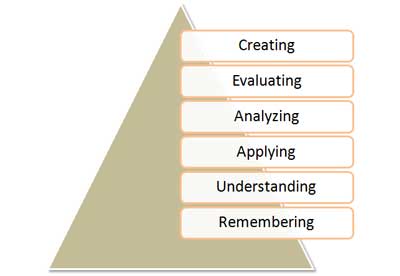
If you have not discovered MERLOT yet, you are missing out on a great resource. MERLOT is a free and open online community of resources designed primarily for faculty, staff and students of higher education from around the world to share their learning materials and pedagogy. If you are teaching an on-line or blended course and would like to plan a virtual field-trip for your students, I encourage you to view Rodica Neamtu's podcast (about 51 minutes long) Crossroads of the Digital and Real Worlds: Virtual Field Trips for Online and Blended Courses. One of the foundational theories used in the scholarship of teaching and learning is Bloom's Taxonomy. A committee of colleges, led by Benjamin Bloom in 1956, identified three domains of educational activities: cognitive, affective, and psychomotor. The cognitive domain involves knowledge and the development of intellectual skills. This includes the recall or recognition of specific facts, procedural patterns, and concepts that serve in the development of intellectual abilities and skills. The affective domain (Krathwohl, Bloom, Masia, 1973) includes the manner in which we deal with things emotionally, such as feelings, values, appreciation, enthusiasms, motivations, and attitudes. The psychomotor domain (Simpson, 1972) includes physical movement, coordination, and use of the motor-skill areas. Development of these skills requires practice and is measured in terms of speed, precision, distance, procedures, or techniques in execution. The application of this information provides a very solid foundation for those of us who are involved in the academic world, especially at a teaching-oriented institution like LU.
Monday, October 4, 2010
ACES Fellow Dr. Jeremy Shelton recommends a chapter entitled "Taking Stock of What Faculty Know About Student Learning" written by Maryellen Weimer, professor emeritus at Penn St. It is from the book Taking Stock: Research on Teaching and Learning in Higher Education. Are you being overwhelmed with requests on your time? Blogger Kerry Ann Rockquemore recommends you create a No Committee. When you are faced with making a decision on a request, tell the person you need to check your schedule and then bring it to your No Committee to discuss the pros and cons of accepting an additional service commitment. Some are predicting that the next U.S. News "Tsunami" will be the inclusion of net-price calculators on university Web sites which will allow families to compare the net prices of colleges. Experts suggest that universities develop net price calculators sophisticated enough to incorporate all institutional grant aid in addition to state and federal sources of aid, thereby lowering the net price that families will see online. Did you know that the best place to start when writing your teaching philosophy is at the end. You need to identify what it is you want your students to know and be able to do when they have completed your class. This decision should be shaped by your own ideas and philosophy and should naturally include developing critical thinking abilities, facilitating the acquisition of life-long learning skills, preparing students to function effectively in a world that is increasingly dependent on electronic resources, and developing problem-solving strategies both within a team and as a leader. Once you have written your teaching philosophy, be sure and share it with a colleague or two for feedback and then continue to revise it as you develop your teaching skills.
Wednesday, September 29, 2010
Working on a paper about attention deficit trait or information overload has prompted me to explore the other alternatives in this scenario. Some researchers are arguing that information overload may not be the problem at all but could be more fundamentally work overload. There may simply be too much to do, too much activity, or too many diverse duties and expectations. Having a balanced work-life load is essential to our mental well being. Our quality of life and attitude effect everything that we do. Solutions to information overload require us to take control of our information environment. Allowing the information to control us brings feelings of powerlessness and anxiety. Dr. Edward Hallowell offers the following tips: get adequate sleep; watch what you eat; exercise; and, take a daily supplement. Sounds like things your parents told you to do. In addition, he says you should: have a friendly face-to-face talk with a person you like every four to six hours; break large tasks into smaller ones; keep a section of your space free of clutter; reserve some "think-time" each day; and, slow down, move around and ask for help. Our thoughts and prayers are with our colleagues at the University of Texas at Austin where tragedy struck yesterday. Colton Tooley, a nineteen year old student, was described by fellow students who knew him as intelligent and incapable of hurting anyone. A U.S. Department of Education sponsored research report claims that the Texas Essential Knowledge and Skills for English language arts and reading standards demand higher levels of cognitive complexity than do the ACT or American Diploma Project (ADP) national college readiness standards sets.
Friday, September 24, 2010
Did you know there is an organization focused on making our region an economic powerhouse? Leadership Southeast Texas (LSET) has brought together 70-80 of the region's citizens each year for the last two decades. The task at hand is to brainstorm ideas on how to improve the region, build the programming, market it internally and externally and work to ensure that the places we call home are sustained. The regional approach is so smart as we try to "compete" with mega-cities like Houston just 80 miles to our west. LU is an economic driver for the nine-county Southeast Texas Region (SETX). In this model, the mission of CTLE becomes even more important. LU is producing the workforce of tomorrow. Our students are critical thinkers who know how to work as part of a team or assume the leadership position. The task at hand for LSET is to harness this brainpower and funnel it to the communities that comprise SETX. Of course we are not alone in this quest. Eric Suder provides a good example of how we can get involved. Switching gears, there is now evidence that you can improve retention, and the University of Illinois at Springfield has done so by assigning staff members to serve as informal advisers and advocates for online students, says Ray Schroeder, director of the Center for Online Learning, Research, and Service. Do you have your students work in small groups? Are your colleagues utilizing the same active teaching method? Research by Hillyard, Gillespie, and Littig, show that student needs to understand and experience the benefits of learning in small groups but it cannot be happening in isolation. It requires campus initiatives and interdepartmental coordination for maximum effectiveness. Why not start a conversation with your colleagues about a sustained effort to utilize small group learning in your department.
Wednesday, September 22, 2010
Want to be evaluated as an excellent teacher by your students? Research by Thomas Sherman and colleagues reveals there are five characteristics that are regularly and consistently attributed to college instructors selected as excellent: enthusiasm, clarity, preparation/organization, stimulating, and love of knowledge. They also report that in addition to these five characteristics, experience appears to be an important component of excellence. But what do you do the first time around? Being honest with your students is always a good policy. Realizing that you are in a learning environment and relaxing also helps. You will not have all of the answers all of the time. Letting your students know that you will find the answer and then making sure to follow up and come to the next class (preferably) with the answer is crucial. In addition, it is always good to ask the other students to participate by providing the answer. An active engagement would include having the students provide at least part of the answer themselves. Are you using your Inbox as a to do list? I heard that loud yes so let me offer you some help. Taskforce is a browser plug-in that interacts with your Google Mail or Google Apps account to help you get those pending items out of your inbox and onto a to-do list where they belong. Taskforce is still in beta, and thus you may run into some surprises as you use it.
Subscribe to:
Posts (Atom)